
Switzerland’s population has a median age of 43 – Its electorate has a median age of almost 60

The median age of Switzerland's resident population is around 43. If we look only at the voting population – those who actually exercise their right to vote in federal elections and Switzerland's instruments of direct democracy (referendums and popular initiatives) – the median age rises to almost 60. In other words, half of all votes cast at the ballot box come from people over the age of 60.
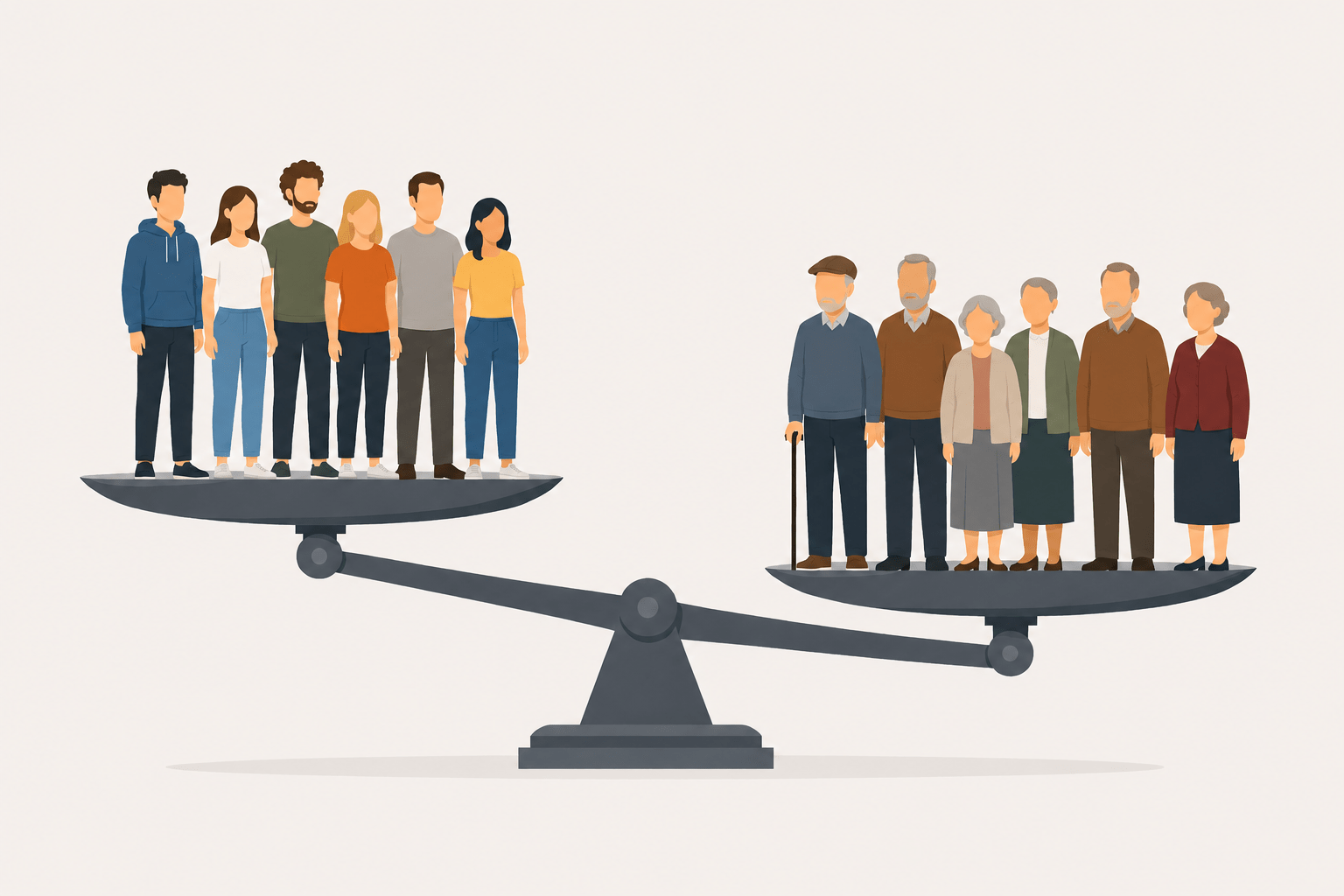
Switzerland's electorate is significantly older than the population
At first glance, the age structure of the Swiss population appears relatively balanced. The median age of the resident population is around 43 years. However, if one considers only those who are eligible to vote and who actually do so, this figure rises significantly.
There are two main reasons for this. Firstly, around a quarter of the Swiss resident population does not have the right to vote in federal elections, either because they do not hold Swiss citizenship or because they have not yet reached the minimum age of 18. Secondly, there are marked differences between generations in terms of political participation. Whilst only around one in three 20- to 29-year-olds votes, participation among 70- to 79-year-olds stands at over 60 per cent. Older people therefore vote roughly twice as often as young adults.
The result is that the median age of today’s electorate is almost 60. This discrepancy fundamentally alters political communication. Whilst the population as a whole is comparatively balanced, at the ballot box it is a significantly older generation that decides on proposals whose consequences will primarily be felt by younger people for decades to come.
What impact does this have on voting?
Age alone does not determine political preferences. Vox post-vote surveys show that younger and older voters reach the same outcome in around three-quarters of all votes, meaning that a pronounced generational divide is the exception rather than the rule. Conversely, however, this also means that in roughly a quarter of votes, the majority view differs between younger and older generations. Personal circumstances and the perceived benefit to oneself play a significant role in shaping political decisions.
When older generations vote at disproportionately high rates, issues such as pensions, healthcare and security tend to carry greater political weight. At the same time, many proposals — for example in climate, education or fiscal policy — particularly affect younger generations, who may have to live with their consequences for decades.
But how representative is direct democracy if the generation that will have to bear the long-term consequences of political decisions for the longest is also the least likely to vote?
What does this mean for political campaigns?
This has important strategic implications for campaign managers.
Firstly, campaigns must know their actual target audience. Those who rely exclusively on social media may achieve reach and attention, but they do not automatically reach the people who ultimately decide at the ballot box. Traditional media and established information channels therefore remain crucial.
Secondly, trust and credibility are becoming increasingly important. Older voters in particular attach great importance to clear arguments, credible sources and established information channels.
At the same time, younger target groups must not be neglected. In the long term, their political participation will determine how representative direct democracy remains. Successful campaigns must therefore not only persuade but also encourage young people to participate in the first place. After all, today’s younger generation is tomorrow’s electorate – those who encourage political participation at an early stage are investing in Switzerland’s democratic future.
How can the median age be reduced?
Various reforms are regularly discussed.
Whilst lowering the voting age to 16 would slightly reduce the median age, it is likely to have only a limited impact. Research findings from Germany suggest that allowing people to vote at an earlier age can slightly increase political participation in the long term – but it is by no means a sure-fire solution. The same applies to extending voting rights to non-citizens at national level: ultimately, the decisive factor remains whether those newly eligible to vote actually vote.
Promoting political participation therefore appears to be a more sustainable approach. Providing political education at an early age, strengthening young people’s sense of political efficacy, and demonstrating that their voice can make a difference all increase the likelihood of regular participation in the long term. At the same time, various studies suggest that even these measures can only partially offset the age-related differences in voting behaviour.
The canton of Schaffhausen provides an example of a significantly more effective measure: it is the only canton in Switzerland with compulsory voting, and its voter turnout is regularly 15 to 20 per cent above the national average. Such a regulation could increase participation, particularly among younger age groups, and thus noticeably lower the median age of the population that actually votes.
However, compulsory voting raises new questions. Should participation in elections and popular votes be a civic duty or a privilege? Is compulsory voting even justifiable in a liberal state such as Switzerland? And what would be the consequences of higher turnout among people who take little interest in political issues?
These questions are also fascinating from the perspective of political communication. Would emotional or oversimplified messages gain in significance if more people who are only superficially informed were to vote? Or would higher turnout strengthen democratic legitimacy overall? There are no clear-cut answers to these questions. However, they do show that a shift towards a younger electorate is not merely a statistical challenge, but also one for democracy itself.
According to Avenir Suisse, the median age of the electorate will continue to rise in the coming years and will only then stabilise at around 61 to 62. This makes the question of who will participate in future elections and popular votes all the more important. After all, the future of direct democracy is decided not only at the ballot box, but also by who finds their way there.
Sources:
- Rühli, L. (2026). Das alte Stimmvolk. Avenir Suisse. Das alte Stimmvolk - Avenir Suisse. https://www.avenir-suisse.ch/publication/das-alte-stimmvolk/.
- Milic, T. (2016). Der Altersgraben an der Stimmurne ist weniger tief als angenommen. Die Volkswirtschaft. https://dievolkswirtschaft.ch/de/2016/10/milic-11-2016/.
- SRF News. (2026). Die abstimmende Bevölkerung wird immer älter. Schweizer Radio und Fernsehen. https://www.srf.ch/news/schweiz/die-haelfte-ist-60-die-abstimmende-bevoelkerung-wird-immer-aelter.
- Faas, T. & Leininger, A. (2020). Wählen mit 16? Ein empirischer Beitrag zur Debatte um die Absenkung des Wahlalters. Otto Brenner Stiftung. https://www.fu-berlin.de/presse/informationen/fup/2020/fup_20_134-studie-wahlalter/index.html.
- Bigler, S. (2014). Wer nicht stimmt, bezahlt. SWI swissinfo.ch. https://www.swissinfo.ch/ger/politik/wer-nicht-stimmt-bezahlt/38282848.